Understanding the MC34063 Power Converter
The MC34063 is a versatile DC-DC converter IC widely used in electronics. Renowned for its efficiency and affordability, this component caters to buck, boost, and inverting configurations. The IC's popularity stems from its ability to manage various power conversion needs with minimal external components, making it an ideal choice for designers balancing performance and cost.
The Versatility of the MC34063 DC-DC Converter
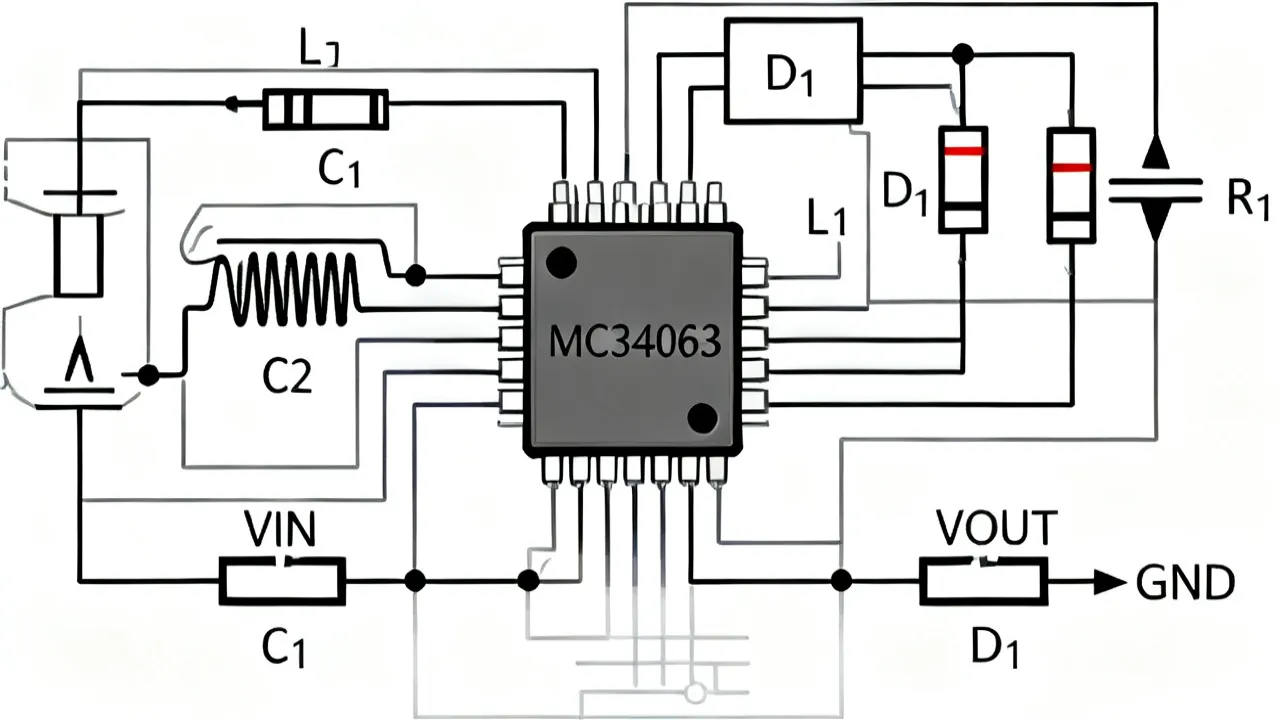
The MC34063 integrated circuit is a staple in power electronics, celebrated for its flexibility and cost-effectiveness. This DC-DC converter IC is capable of efficiently handling buck (step-down), boost (step-up), and inverting conversion topologies. Its widespread adoption in the electronics industry is driven by its ability to cater to various power conversion needs with a simplistic design approach. Over the years, the MC34063 has found its place in a multitude of devices, ranging from portable gadgets to industrial machines, making it an essential component for engineers and designers.
Key Features and Specifications
Engineered to provide efficiency in power conversion, the MC34063 offers numerous key features:
- Wide input voltage range: 3V to 40V
- Output switch current in excess of 1.5A
- Internal 1.2V bandgap reference for accurate output
- Low standby current minimizing energy loss
- Adjustable output voltage from 1.25V to 37V
- Thermal overload protection ensuring reliability
- Low-cost solution facilitating mass production
This specification map underscores the IC's compelling proposition in delivering operational versatility and reliability. Additionally, the MC34063's ability to work with a variety of external components allows for great customization, making it suitable for a diverse range of applications.
Applications in Electronic Design
From consumer electronics to industrial applications, the MC34063 sees usage across various sectors. Its robust architecture supports cost-sensitive projects and complex designs requiring reliable regulation under different load conditions. Common applications include:
- Battery chargers for rechargeable devices, providing regulated charging voltages.
- Step-up converters for microcontroller power adjustments, ensuring stable operation.
- Negative voltage applications in inverters where current direction is reversed.
- Small switching power supplies for electronic devices due to compact design.
- Powering light-emitting diodes (LEDs) where consistent voltage is critical.
- Automotive applications such as power supplies for various onboard sensors.
Moreover, the adaptability of the MC34063 allows for incremental improvements in traditional designs, thereby enhancing the performance of devices in specific applications. Its versatility ensures that it is not just limited to standard roles but rather expands into innovative uses that drive technological progress in fields like IoT (Internet of Things) and wearable technology.
Comparison with Other ICs
| IC Model | Input Voltage Range | Max Output Current | Applications | Efficiency |
|---|---|---|---|---|
| MC34063 | 3V to 40V | 1.5A | Multiple topologies including step-up, step-down, and inversion | Typically up to 85% |
| LM2577 | 3.5V to 40V | 3A | Boost converter applications | Typically up to 90% |
| LM7805 | 7.5V to 20V | 1.5A | Linear voltage regulation, constant output | Lower due to linear regulation |
| TPS54331 | 4.5V to 17V | 3A | Step-down applications for modern electronics | Up to 95% |
The MC34063 holds its ground against other ICs in various aspects, particularly when we consider its ability to work across multiple conversion topologies. While it may not always have the highest efficiency compared to newer alternatives, its simplicity and low cost make it a go-to choice for many applications where high power efficiency is not the primary concern.
Implementation Insights for Designers
The true power of the MC34063 lies in its adaptability. By adjusting external components, designers can configure the IC for desired output voltage and current characteristics. Thus, successful implementation requires careful consideration of several critical factors:
- Choosing the right inductor value to prevent saturation, as the inductor plays a crucial role in the overall performance of the power conversion process. Selection of inductor should take into account the application's current needs and transient response times.
- Calculating an appropriate output filter capacitor for voltage ripple reduction, which is important in maintaining stable output. This capacitor smoothens the voltage output, providing better performance in sensitive electronic circuits.
- Designing the feedback network for stable output voltage through appropriate resistive divider configurations, ensuring that output voltage stays within preset levels under varying load conditions.
- Using high-quality diodes to prevent reverse current and voltage spikes that could harm the circuit. Schottky diodes are often preferred due to their low forward voltage drop and fast switching capabilities.
- Incorporating transient response analysis in the design phase to predict how the circuit performs under dynamic load conditions.
Understanding these key elements can significantly impact design efficacy and optimize performance outcomes. Furthermore, simulation software can be beneficial in predicting circuit behaviors before physical prototyping, allowing designers to fine-tune their configurations efficiently.
FAQs
- What is the MC34063 used for?
The MC34063 is used in power supply systems for converting voltage levels, providing step-up, step-down, and inverted outputs, which is particularly beneficial in battery-powered applications.
- How does the MC34063 compare in efficiency?
While highly efficient for its class and price, improvements in circuit tuning and component selection can enhance real-world performance. It is important to note that design choices, such as component quality and layout, also significantly affect overall efficiency.
- Is the MC34063 suitable for low-power applications?
Yes, it is advantageous for low to medium power designs where cost and versatility are priorities. The IC’s flexibility in configuring output makes it particularly appealing in battery management systems and energy-sensitive devices.
- Can the MC34063 handle high-frequency applications?
While it is capable of operating at frequencies typically ranging from 100 kHz to 200 kHz, the MC34063 is not optimized for high-frequency applications. However, with careful design considerations, it can still perform adequately in moderate frequency environments.
- What are the limitations of using the MC34063?
One of the primary limitations of the MC34063 is its lower efficiency compared to newer switching regulators. Additionally, it may not perform well in applications requiring high power levels or very low output voltages.
Conclusion
The MC34063 remains a reliable and flexible solution in modern electronics design. Its adaptability across various configurations makes it indispensable for engineers and hobbyists alike. By understanding its specifications and appropriate application contexts, designers can effectively harness its capabilities to achieve efficient power conversion solutions. As we continue to advance in technology, the role of versatile components like the MC34063 will be crucial in creating efficient, reliable, and cost-effective designs that cater to the demands of the ever-evolving electronics landscape. Whether in emerging green technologies or conventional circuits, the MC34063 stands as an enduring testament to the importance of innovation and adaptability in power electronics.
-
1

Explore the Tranquil Bliss of Idyllic Rural Retreats
-
2
Unlock the Full Potential of Your RAM 1500: Master the Art of Efficient Towing!
-
3
Leveraging High-Interest CDs for Optimized Investment Returns
-
4
How to Take Advantage of Debt Consolidation Loans: Key Strategies
-
5
Understanding Debt Consolidation Loans: Weighing Advantages and Disadvantages